
Table of Contents
- Why Gear Maintenance Decides Whether Your Kit Works
- Survival Gear Storage Best Practices
- Survival Gear Inspection Checklist
- How to Clean Tactical Backpacks
- Preventing Rust on Survival Tools
- Gear Rotation, Kit Replenishment, and Exercise Protocols
- Frequently Asked Questions
Last Updated: September 22, 2026
Why Gear Maintenance Decides Whether Your Kit Works
Survival gear fails at the worst possible moment when you treat it as a purchase instead of a system you maintain survival gear within. Learning how to maintain survival gear for longevity is the difference between a pack that performs for a decade and one that fails on day three of a backcountry trip.
Most kits fail because of chemistry, not abuse, gear degrades whether you use it or not.
The Lifecycle of Survival Gear
Every piece of equipment moves through four stages: new, broken-in, degrading, and unreliable. Most people only notice the last stage, usually mid-trip.
The fix is preventative maintenance: a scheduled approach that catches degradation while it’s still reversible. Waiting for visible damage is a mistake, by then, failure has already started.
The 5 C’s and Why Each One Degrades
The classic survival priorities (cutting, combustion, cover, container, cordage) each fail differently. Cutting tools corrode. Fire starters absorb moisture. Shelter fabrics break down under UV light. Containers crack at stress points. Cordage loses tensile strength through abrasion and chemical exposure.
Understanding why each degrades tells you what to inspect and how often.
Survival Gear Storage Best Practices
Survival gear storage best practices start with three controls: moisture, temperature, and light. Get them right and you eliminate most of the slow damage that ruins idle equipment.
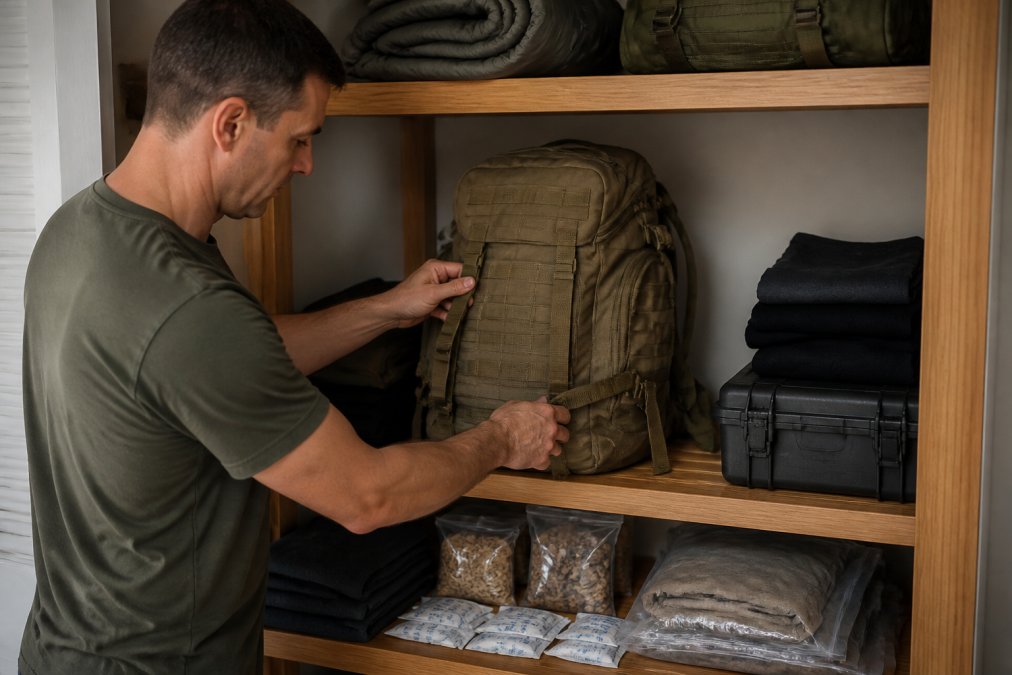
Store your kit in a cool, dark space away from concrete floors, which wick moisture into fabric and metal.
How UV and Humidity Chemically Break Down Synthetic Gear
Synthetic fabrics and polymers don’t just get dirty, they chemically degrade, driven mainly by ultraviolet light and moisture.
UV and moisture don’t just wear gear out, they break it down chemically. Storage is the only maintenance task that prevents damage you can’t see or repair.
Moisture Control with Silica Gel Packets
Silica gel packets are the cheapest insurance in your kit. Toss a few into every bag, ammo can, and storage bin, then replace them on a schedule rather than waiting for visible failure.
Vacuum Sealing and Climate-Controlled Storage
Vacuum sealing protects emergency rations, fire tinder, and spare batteries from moisture and oxidation, the single most effective method for anything untouched for months. Oxygen absorbers inside the pouch further slow oxidation of metals and fats.
Matching Containers to Contents
Different gear needs different storage hardware. A single bin for everything is a common mistake.
- Ammo cans and hard cases: best for tools, batteries, and anything metal. Add a desiccant pack and a small label with the pack date.
- Vacuum-sealed Mylar: best for rations, tinder, and spare batteries you won’t touch for a year or more.
- Breathable cotton or canvas bags: best for items that need airflow, like treated leather or gear you rotate frequently.
- Opaque plastic bins with gasketed lids: best for bulk fabric items like tarps, packs, and sleeping bags. Keep them off concrete.
Survival Gear Inspection Checklist
A survival gear inspection checklist turns vague “looks fine” assessments into a repeatable process. Run it quarterly for active kits and annually for stored backups, aiming to catch the specific failure modes each category develops over time.
Work through each category systematically:
- Blades: check for rust, nicks, and edge retention. Run a thumbnail along the edge, if it slides instead of catching, it needs sharpening.
- Fire starters: test ignition, inspect for moisture. Ferro rods should throw sparks on the first strike; lighters should light within three flicks.
- Shelter: inspect seams, waterproofing, and pole integrity. Look for sticky or flaking coating, which signals hydrolysis.
- Water filtration: verify flow rate and seal integrity. A filter that has slowed noticeably is clogged and needs backflushing or replacement.
- Batteries: check for leakage and voltage. A multimeter reading below 1.2V on a nominally 1.5V cell means it’s on its way out.
- Cordage: look for fraying, stiffness, or discoloration. Stiffness in paracord usually means UV or chemical damage.
- First aid: confirm nothing has expired. Check adhesive, antiseptics, and medications specifically.
- Fasteners: test every zipper, buckle, and strap. Zippers should glide without catching; buckles should click positively.
Quarterly and Annual Inspection Schedules
Quarterly inspections catch wear before it becomes failure. Annual inspections go deeper: full disassembly, deep cleaning, and replacement of anything marginal.
Photograph your kit after each inspection. Comparing photos over time reveals slow degradation, like UV fading or creeping corrosion, that your eyes miss in person.
Gear Exercise Protocols: The Step Most Guides Skip
Most inspection advice stops at “look at it,” missing a real failure mode: gear that seizes from disuse. Rubber seals take a set, lubricants dry out, batteries self-discharge, stoves gum up. The fix is a structured gear exercise protocol, a schedule for operating stored equipment so it doesn’t freeze in place.
A practical exercise cadence looks like this:
- Every 90 days: cycle every battery-powered device on for five minutes. This keeps capacitors formed and confirms the device still powers on.
- Every 90 days: strike every fire starter two or three times. Ferro rods can oxidize; flint wheels can seize.
- Every 6 months: fire up every stove and lantern for a few minutes. Run them long enough to burn off old fuel residue and confirm the jet isn’t clogged.
- Every 6 months: open and reseat every dry bag and waterproof container. This keeps seals from taking a permanent set.
- Annually: deploy the shelter. Pitch the tent or tarp, tension the guy lines, and let it sit for an hour. This reveals seam failures and pole cracks that folded storage hides.
- Annually: run water through every filter. A filter that sits dry for years can develop brittle housing or seized valves.
Reliability Testing Before You Trust Your Kit
Reliability testing means actually using your gear before you need it. Fire starters get struck. Filters get run. Headlamps get left on until they die.
How to Clean Tactical Backpacks
Learning how to clean tactical backpacks correctly protects the fabric and hardware that carry your load. Machine washing or harsh detergent strips waterproofing and weakens seams.
Fabric Care for Denier Nylon and Cordura
Denier nylon and Cordura are tough but not indestructible. UV degradation slowly breaks down synthetic fibers, so sun exposure does more long-term damage than dirt ever will.
Never store a damp pack. Mildew eats through coated fabric and leaves a permanent smell. If you smell mustiness, the coating is already compromised.
Checking Seal Integrity and Zippers
Seal integrity on waterproof bags and dry sacks matters more than the fabric itself. Fill a dry sack with air, seal it, and squeeze. Any hiss means the seal has failed.
Preventing Rust on Survival Tools
Preventing rust on survival tools comes down to three habits: dry thoroughly, coat lightly, and store correctly. Corrosion resistance is a property of the steel, but maintenance decides whether it holds.
Lubrication and Corrosion Resistance for Blades
After every trip, wipe blades clean, dry them completely, and apply a thin coat of oil. Use food-safe oil for knives that touch food; gun or tool oil for axes and multi-tools.
The single biggest cause of tool failure is storage, not use. A well-oiled blade in a dry sheath outlasts a neglected one by years.
Gear Rotation, Kit Replenishment, and Exercise Protocols
Gear rotation means cycling older stock into active use before it expires, then replacing it. Treat your kit like a pantry: first in, first out.
Food, Water, and Battery Shelf Life
Emergency rations last longest vacuum-sealed and stored cool. Check dates quarterly and rotate anything within six months of expiry into regular use.
Digital Asset Preservation and Field Repair Skills
Digital asset preservation is the maintenance task almost nobody plans for. Offline maps, downloaded route files, and emergency contact lists need periodic updates and backup on multiple devices. A phone with a dead battery and outdated maps is dead weight.
| Task | Frequency | Why It Matters |
|---|---|---|
| Quarterly kit inspection | Every 3 months | Catches wear before failure |
| Desiccant replacement | Every 3-6 months | Saturated packets stop working silently |
| Blade cleaning and oiling | After every trip | Prevents rust and pitting |
| Battery check and rotation | Quarterly | Stops leakage and dead cells |
| Ration and water rotation | Every 6 months | Maintains shelf life and freshness |
| Full reliability test | Annually | Confirms gear works under load |
Frequently Asked Questions
How often should I inspect my survival gear for degradation?
Run a full inspection every quarter and a deeper annual review. Check blades for corrosion, synthetic fabrics for UV degradation, batteries for leakage, and food and water for expired shelf life. Between these checks, do a quick visual scan before each trip. Quarterly inspections catch small issues like loose stitching or a failing seal before they become mechanical failures in the field.
What is the best way to store survival gear to prevent rust and mold?
Store gear in a cool, dry, climate-controlled space away from direct sunlight. Use silica gel packets or a desiccant in every compartment to control moisture, and vacuum seal items you rarely touch. Keep blades lightly oiled and never store a wet backpack. Avoid garages and basements where humidity swings accelerate corrosion and mold growth on denier nylon and load-bearing equipment.
How do you maintain carbon steel survival knives?
Carbon steel needs more attention than stainless. Dry the blade completely after every use, then apply a thin coat of oil or a purpose-made protectant. Sharpen with a consistent angle using a whetstone or guided sharpener, and store the knife in its sheath only when fully dry. Check for pitting during your quarterly inspection, since carbon steel trades corrosion resistance for edge retention.
How do you check the integrity of synthetic fabrics in tactical backpacks?
Inspect seams, zippers, and strap attachment points for fraying, loose threads, or separation. Hold the pack up to a light source to spot thin spots or pinholes. Test zippers by running them the full length under light tension. UV degradation weakens nylon over time, so if the fabric feels chalky or has faded unevenly, it has likely lost strength and needs repair or replacement.




0 Comments