
Table of Contents
- What Separates Long Lasting Camping Equipment From Disposable Gear
- Core Camping Gear Essentials Worth Investing In
- How to Maintain Camping Equipment So It Lasts for Years
- Repairing Camping Equipment: Field Fixes and At-Home Repairs
- How to Spot Durable Camping Gear Brands Before You Buy
- Sustainability and Gear Lifecycle: Getting More Years From Every Item
- Frequently Asked Questions
Last Updated: September 19, 2026
What Separates Long Lasting Camping Equipment From Disposable Gear
A long lasting camping equipment guide starts with an uncomfortable truth: most gear fails because of how it was chosen, not how it was used. A long lasting camping equipment guide starts with an uncomfortable truth: most gear fails because of how it was chosen, not how it was used.
Materials and Construction That Survive Real Trips
The biggest predictor of longevity is the fabric and the seams, not the brand logo. Ripstop nylon and polyester resist tearing because the reinforcing grid stops small snags from becoming full rips. Denier ratings tell you the fabric’s weight and durability: higher denier means a heavier, tougher weave; lower denier means lighter but more fragile, which decides whether rocky campsites leave scuffs or holes.
A common mistake is buying on denier alone. A high-denier fabric with poor seam sealing will still leak at the stitching. Check that seams are taped or sealed, not just that the fabric feels thick.
The Decision Framework: Five Questions Before You Buy
Before any purchase, run the gear through five questions. Fail two or more, walk away.
| Question | What a “Yes” Looks Like | Why It Matters |
|---|---|---|
| Can I repair it? | Replaceable parts, available patches | Extends lifespan for years |
| Is the fabric rated for my terrain? | Denier and ripstop match use | Prevents punctures and tears |
| Are the seams sealed? | Taped or welded construction | Stops leaks at stress points |
| Does it pack down small? | Compresses without stressing zippers | Reduces wear during transport |
| Is it weather-resistant? | Handles your worst expected conditions | Avoids premature failure |
Core Camping Gear Essentials Worth Investing In
Not every item deserves your money. Some gear you can replace cheaply and often; other pieces you should buy once and maintain for a decade. For each essential below, ask: what construction detail decides whether this item survives five seasons or one?
Shelter and Sleeping Systems
Your shelter and sleeping system is the foundation of every trip, and the worst place to cut corners. A tent with a proper groundsheet, sealed seams, and a weather-resistant fly will outlast three cheap tents combined, and warmth from quality insulation is a safety issue, not a comfort one.
Camp Kitchen and Cooking Supplies
A camp kitchen survives on simple, heavy-duty construction: stoves with few moving parts fail less, cookware with thick bases resists warping over open flame, and one-piece metal utensils won’t snap at a folding joint.
Lighting, Power, and Navigation
Portable power and lighting are where cheap gear fails fastest, usually at the worst moment. A headlamp with a durable housing and a replaceable battery outlasts a sealed disposable unit. A power bank with solid cells holds its capacity through hundreds of charge cycles.
The through-line across every essential: buy the version whose failure points you can see, reach, and replace. Sealed, glued, and proprietary parts are the enemy of a decade-long lifespan.
How to Maintain Camping Equipment So It Lasts for Years
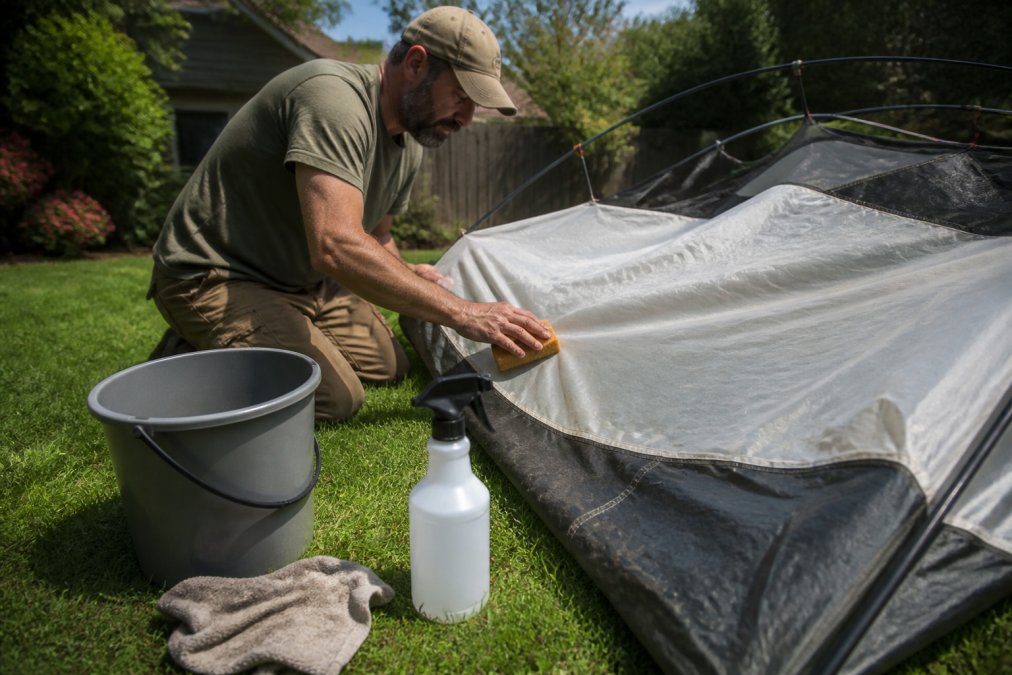
Learning how to maintain camping equipment is the highest-return habit in this guide. Most gear doesn’t wear out from use; it wears out from neglect between trips. A tent packed away damp grows mildew, a gritty zipper grinds itself down, and a stove left with fuel residue clogs. The routines are simple, cheap, and take minutes per item, the difference between a five-year tent and a fifteen-year one.
Cleaning, Drying, and Storage Routines
- Clean fabric gear with mild soap and water, never harsh detergents
- Dry everything completely before storage, including straps and seams
- Store tents and bags loosely, never compressed long-term
- Lubricate zippers and moving parts with a gear-safe lubricant
- Reapply waterproofing treatment at least once a season
- Check for small tears and patch them before they spread
Material-Specific Care: What Each Fabric and Surface Actually Needs
The right care depends on what the gear is made of.
Store sleeping bags hanging or loosely stuffed, never in their compression sack. Compressing insulation for months crushes the loft permanently, and a bag that won’t loft won’t keep you warm.
A Simple Seasonal Maintenance Calendar
Tie the routines to the calendar:
- After every trip: air out and dry all fabric gear, empty and wipe the stove, brush zippers.
- Start of season: inspect seams and coatings, reapply DWR, check pole shock cord and pad valves, test headlamps and power banks.
- End of season: deep-clean and re-treat shells, wash and loft sleeping bags, store everything loose and dry, and note any repairs to tackle before next season.
When to Repair, When to Retire: A Gear Lifecycle Check
At some point an item crosses from “worth fixing” to “time to replace,” and knowing that line saves money and prevents a field failure.
- Tents: repairable until the coating delaminates across large panels or the pole set has multiple broken sections. A single torn panel or a snapped pole is a fix, not a funeral.
- Sleeping bags: retire when the shell is worn through and the insulation has lost loft even after washing and drying.
- Sleeping pads: replace when the valve or seam leaks can’t be patched and the pad won’t hold air overnight. A slow leak you can’t find is the classic end-of-life signal.
- Stoves: rebuildable stoves can last decades with new O-rings and jets. Retire a stove when the body is cracked or the maker no longer stocks parts.
- Headlamps and power banks: replace when the battery no longer holds a useful charge, since sealed cells usually aren’t user-replaceable.
Maintenance is a habit, not a chore. Ten minutes after each trip and one deep-clean per season will add years to every item in your kit, and the lifecycle check tells you when to stop fixing and start replacing.
Repairing Camping Equipment: Field Fixes and At-Home Repairs
Repairing camping equipment turns a five-year item into a fifteen-year item. Treat every tear, bent pole, and sticky zipper as fixable until proven otherwise, most field damage is repairable on the spot.
What to Carry in a Repair Kit
A repair kit should cover the failures you’re most likely to hit. Keep it small but complete:
- Tenacious fabric patches for tent and pack tears
- A pole splint or repair sleeve for broken tent poles
- Spare cord and shock cord for guy lines and pole tensioners
- A multi-tool with pliers and scissors
- Gear-safe lubricant for zippers
- Seam sealant for re-sealing stressed stitching
- Duct tape wrapped around a water bottle for emergency fixes
How to Spot Durable Camping Gear Brands Before You Buy
Durable camping gear brands share a few tells, and none is the price tag. The reliable signal is whether a brand sells replacement parts: a company that stocks pole sections, buckles, and patch kits expects its gear to be repaired, not replaced.
The best durability signal isn’t a warranty claim or a marketing badge. It’s whether the brand sells you the parts to fix your own gear.
Sustainability and Gear Lifecycle: Getting More Years From Every Item
Gear lifecycle thinking is the most overlooked angle in camping, and it’s where the biggest wins hide. Every item you repair instead of replace is one less item manufactured, shipped, and eventually landfilled. The EPA guidance on reducing waste frames it plainly: the most effective way to cut waste is to keep products in use longer.
Frequently Asked Questions
What are the most durable materials for camping equipment?
Look for high-denier ripstop nylon or polyester for tents and packs, since 210D to 420D fabrics resist abrasion far better than thin 20D shells. Aluminum poles outlast fiberglass, and YKK zippers hold up longer than generic ones. For waterproofing, silicone-coated or polyurethane-coated fabrics shed rain without cracking. Wool and synthetic blends keep insulation working even when damp, and stainless or titanium cookware resists rust and dents across many seasons of long lasting camping.
How do you maintain camping gear to ensure it lasts for years?
Clean and dry everything before storage, since trapped moisture causes mildew, rust, and delamination. Wash tents with mild soap, never detergent, and re-waterproof seams annually. Lubricate zippers with silicone, not oil. Store sleeping bags loose, not compressed, and keep packs off concrete floors. Check straps, buckles, and pole shock cords before each trip. This simple routine is the core of how to maintain camping equipment so it survives years of use.
How can you tell if camping gear is high-quality before buying?
Inspect construction details: double-stitched seams, bartacked stress points, taped or sealed fly seams, and metal hardware instead of plastic. Check the denier rating on fabric, the warranty length, and whether the brand sells replacement parts. A company that stocks repair buckles, pole sections, and patch kits expects its gear to be used for years. That parts support is one of the clearest signals of durable camping gear brands.
What should I include in a camping equipment repair kit?
Carry a patch kit for tent and sleeping pad fabric, spare pole sections or a splint sleeve, a multi-tool, duct tape, seam grip adhesive, spare zipper pulls, cord, and a small sewing kit with heavy thread. Add replacement buckles sized to your pack straps. For stove repairs, a small wrench and spare O-rings cover most field failures. This kit handles nearly all common repairing camping equipment situations without ending your trip early.
Is expensive camping gear actually worth it if I only camp a few times a year?
Cost per trip is the honest measure. A budget tent replaced every two seasons costs more over five years than one quality tent that lasts a decade. For occasional campers, focus spending on the items that fail most: shelter, sleeping pad, and footwear. Buy mid-range versions of everything else. Durable gear also holds resale value, so if your trips taper off, you can recover part of the cost.
What is the 3-3-3 rule for camping?
The 3-3-3 rule is a trip-planning guideline: arrive at camp by 3 p.m. so you have daylight to set up, stay at least three days to make the trip worthwhile, and plan to be self-sufficient for three days if something goes wrong. It pairs well with a long lasting camping equipment guide because the self-sufficiency part depends on gear that will not fail when a trip runs longer than expected.





0 Comments