
Table of Contents
- What Makes the Best Tactical Backpacks for 2026 Stand Out
- Top Tactical Backpacks for 2026: Reviewed and Ranked
- 5.11 Tactical RUSH72 2.0: Best for Bug-Out Capacity
- GORUCK GR1: Best for Everyday Durability and Travel
- Direct Action Dragon Egg Mk II: Best Lightweight Option
- Vertx Gamut 2.0: Best for Concealed Carry
- Maxpedition Falcon-III: Best Mid-Size Workhorse
- Mystery Ranch 3 Day Assault CL: Best for Rapid Access
- Triple Aught Design FAST Pack EDC: Best Premium Modular Pick
- Tactical Backpack vs Hiking Backpack: Which Do You Actually Need?
- How to Build Your EDC Tactical Backpack Setup
- How to Pack a Bug-Out Bag the Right Way
- TSA Compliance, Travel, and Field Maintenance Tips
- Conclusion
Last Updated: August 26, 2026
What Makes the Best Tactical Backpacks for 2026 Stand Out
Tactical backpacks have evolved far beyond their military origins. At Adventurers Pulse, we’ve evaluated what separates a pack that holds up across seasons of hard use from one that fails quickly: material specification, modular architecture, and ergonomic engineering.
The market is flooded with gear that looks tactical but isn’t. Coyote-brown fabric and MOLLE loops don’t make a pack field-worthy. What does is proven construction standards, thoughtful compartmentalization, and a suspension system that distributes load-bearing stress across your hips and core rather than grinding your shoulders.
Material Durability: Denier, Cordura, and Ballistic Nylon
Denier measures thread weight and determines abrasion resistance. Higher denier means tougher material; lower denier means lighter weight. Most quality tactical backpacks fall in the 500D to 1050D range.
Cordura fabric is an Invista-licensed nylon known for tear and abrasion resistance, the baseline standard for serious tactical gear. Ballistic nylon, originally developed for military flak jackets, offers exceptional puncture resistance and is commonly used in packs rated for law enforcement or military specification use.
For most outdoor enthusiasts, 500D to 1000D Cordura hits the sweet spot between weight and durability. If you’re running a bug-out bag that may sit loaded for months then take serious abuse, 1050D ballistic nylon is worth the added weight. YKK zippers are the industry standard for consistent pull weight, corrosion resistance, and reliability.
Check the denier rating on the base panel specifically. Manufacturers sometimes use higher-denier fabric on the main body but cut costs on the base, which experiences the most abrasion from ground contact.
MOLLE, PALS, and Laser-Cut Webbing Systems
MOLLE (Modular Lightweight Load-carrying Equipment) is the attachment standard that allows you to add pouches and accessories using interlocking webbing. PALS (Pouch Attachment Ladder System) refers to the specific grid of webbing rows that MOLLE accessories attach to.
Traditional PALS webbing is stitched fabric, which adds weight and creates friction points. Laser-cut webbing is the modern evolution: channels are precision-cut directly into the pack’s outer material, reducing weight while maintaining full MOLLE compatibility. A well-designed MOLLE/PALS system lets you configure your load for the specific mission, whether that’s a day hike, a patrol, or a multi-day wilderness push.
Suspension Systems, Ergonomics, and Load Carriage
The biggest mistake most buyers make is ignoring the suspension system and focusing only on capacity. A 55-liter pack with a poor harness will destroy your back on a 10-mile carry. A 30-liter pack with properly engineered suspension will feel manageable at day’s end.
Load carriage engineering covers three key components: padded shoulder straps that contour to your torso, a sternum strap that prevents shoulder straps from splaying outward under load, and a waist belt that transfers weight from your shoulders to your hips. For anything over two hours, a hip transfer system is non-negotiable (the NIH). Internal frame packs use an aluminum stay bar or frame sheet to maintain structure and distribute weight. For those with shoulder injuries or chronic back pain, waist belt fit matters most, look for packs where the waist belt sits on your iliac crest (hip bone), not your lower back.
Top Tactical Backpacks for 2026: Reviewed and Ranked
Quick Picks:
- Best Overall / Bug-Out Capacity: 5.11 Tactical RUSH72 2.0
- Best for Everyday Durability and Travel: GORUCK GR1
- Best Lightweight Option: Direct Action Dragon Egg Mk II
- Best for Concealed Carry: Vertx Gamut 2.0
- Best Mid-Size Workhorse: Maxpedition Falcon-III
- Best for Rapid Access: Mystery Ranch 3 Day Assault CL
- Best Premium Modular Pick: Triple Aught Design FAST Pack EDC
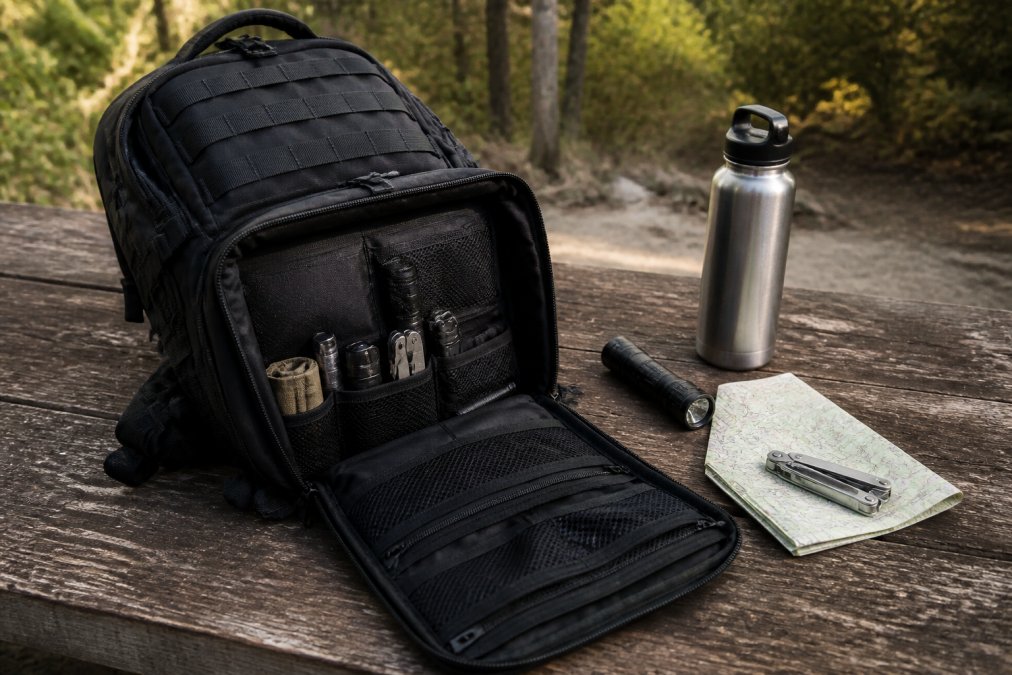
5.11 Tactical RUSH72 2.0: Best for Bug-Out Capacity
The RUSH72 2.0 is the benchmark for bug-out bag builds. At 55 liters, it carries three days of serious gear without forcing you to choose between your first aid kit and shelter system. The 1050D nylon construction handles heavy loads well with its contoured yoke shoulder strap system, aluminum stay bar, and waist strap. The hidden CCW pocket is secure, external MOLLE webbing provides substantial modular attachment, and a padded laptop sleeve fits up to 15 inches.
Best for: Three-day bug-out bag builds, extended wilderness missions, emergency preparedness.
GORUCK GR1: Best for Everyday Durability and Travel
GORUCK built the GR1 on Special Forces rucksack principles. Available in 21L and 26L configurations, it may be the most indestructible pack available. The bombproof laptop compartment is designed to protect a laptop in combat conditions and handles daily commuting, travel, and trail use without concern. The thick, well-padded harness system is one of the most comfortable on the market for heavy loads. The price point is high, but for frequent travelers who also use their pack in demanding outdoor environments, it justifies itself.
Best for: Daily carry, travel, rucking, anyone who wants a pack that genuinely lasts decades.
Direct Action Dragon Egg Mk II: Best Lightweight Option
The Dragon Egg Mk II solves a real problem: most tactical backpacks in the 25-liter range are either too heavy or too under-featured. Direct Action’s laser-cut MOLLE/PALS system keeps weight down without sacrificing modular attachment. The Combat Vent System provides meaningful back panel airflow on warm-weather carries. At 25+ liters with three zippered compartments and a padded 15-inch laptop sleeve, the organization is well-thought-out.
Best for: Law enforcement patrol, lightweight EDC, outdoor enthusiasts who want tactical features without tactical weight.
Vertx Gamut 2.0: Best for Concealed Carry
The Vertx Gamut 2.0 is the most purpose-built CCW pack on this list. The weapon-compatible concealed carry platform uses loop lining and a Rapid Access Pull tab that allows a clean, one-handed draw without telegraphing the motion. The "grey man" aesthetic is the Gamut 2.0’s most underrated feature, it looks like a quality everyday backpack, not a tactical rig. The 3D-molded foam back panel improves airflow compared to flat panel designs.
Best for: Concealed carry permit holders, prepared professionals, urban EDC users who need discreet quick-access.
Maxpedition Falcon-III: Best Mid-Size Workhorse
Maxpedition’s 1050-denier water and abrasion resistant ballistic nylon construction is built to law enforcement grade standard and priced more accessibly than many competitors. The accordion design collapses to a low profile when empty. The CCW pocket fits large pistols and uses lockable zippers. At 28 liters, it sits in the practical sweet spot between a daypack and a full mission bag.
Best for: Daily use, day trips, multi-day missions where mid-size capacity is the right call.
Mystery Ranch 3 Day Assault CL: Best for Rapid Access
The 3-Zip design sets the Mystery Ranch 3 Day Assault CL apart. Three separate zippers open the main compartment to give immediate, full visibility of your loadout without digging. At 34 liters, the capacity is right for a genuine three-day mission or an aggressive two-day wilderness push. The internal sleeves accommodate up to three hydration reservoirs, and the built-in laptop sleeve fits up to 17 inches.
Best for: Tactical operators, outdoor enthusiasts, travelers who prioritize speed of access.
Triple Aught Design FAST Pack EDC: Best Premium Modular Pick
The FAST Pack EDC is the most modular pack on this list and the most expensive. The combination of 1000D and 500D Invista Cordura fabric, extensive PALS webbing, and anchor points throughout creates a platform configurable for almost any load requirement. The full-zip clamshell opening gives immediate access to the entire main compartment. The weather-resistant flat compartment with roll-top closure for laptops and documents keeps your electronics dry without requiring a separate rain cover.
Best for: Serious tactical users, outdoor enthusiasts who want a lifetime pack.
| Pack | Capacity | Key Material | CCW | Laptop Sleeve | Best For |
|---|---|---|---|---|---|
| 5.11 RUSH72 2.0 | 55L | 1050D nylon | Yes | Up to 15" | Bug-out / extended missions |
| GORUCK GR1 | 21L / 26L | Military-grade nylon | No | Bombproof compartment | Daily carry / travel |
| Direct Action Dragon Egg Mk II | 25L+ | Laser-cut MOLLE | No | Up to 15" | Lightweight EDC / patrol |
| Vertx Gamut 2.0 | Not specified | 3D foam panel | Yes (dedicated) | Up to 15" | Concealed carry / urban EDC |
| Maxpedition Falcon-III | 28L | 1050D ballistic nylon | Yes | No | Mid-size daily / missions |
| Mystery Ranch 3 Day Assault CL | 34L | Durable nylon | No | Up to 17" | Rapid access / 3-day missions |
| TAD FAST Pack EDC | 28L | 1000D / 500D Cordura | No | Roll-top flat compartment | Premium modular carry |
Tactical Backpack vs Hiking Backpack: Which Do You Actually Need?
A tactical backpack is a load-bearing platform designed around modular attachment, quick access, and durable construction for demanding environments. A hiking backpack is optimized for sustained comfort over long distances, with emphasis on ventilation, hip transfer, and lightweight materials.
Hiking packs prioritize gram counting and ventilated back panels. Tactical backpacks prioritize compartmentalization, MOLLE attachment, and material durability. For multi-day wilderness trips covering serious mileage, a purpose-built hiking pack often makes more sense. For preparedness-focused use, EDC builds, or environments where you need modular attachment and quick access, tactical backpacks win. Many outdoor enthusiasts are well-served by a tactical pack for preparedness and EDC use, and a separate hiking pack for long-distance trail use. If you want one pack for both, look at options like the Mystery Ranch 3 Day Assault CL or the GORUCK GR1, which blend tactical durability with hiking-appropriate ergonomics.
How to Build Your EDC Tactical Backpack Setup
An EDC tactical backpack setup is a daily-carry system built around a core pack and a consistent, repeatable organization scheme. The goal is to access any item within seconds without emptying the bag.
Choosing the Right Capacity for Daily Carry
For most EDC applications, 21 to 30 liters is the functional range. Below 21 liters, you’re compromising on organization. Above 30 liters, the pack becomes unwieldy for daily transit.
The right capacity depends on your specific carry list:
- 21-26L: Laptop, daily essentials, light EDC kit, one day’s hydration
- 26-30L: Above plus compact first aid kit, additional clothing layer, larger hydration capacity
- 30L+: Full EDC kit, extended-day or overnight capability
Start with your non-negotiable carry items, then choose the smallest pack that accommodates them with organized access.
Laptop and Electronics Protection in an EDC Pack
Electronics protection comes down to three factors: sleeve padding, suspension isolation, and water resistance. A padded laptop sleeve that suspends the device away from the pack’s base panel is the baseline. Packs like the GORUCK GR1 take this further with a bombproof compartment designed to absorb impact. For field environments or travel, look for a water-resistant outer shell and consider a separate dry bag for electronics in wet conditions.
The best electronics protection combines a suspended, padded sleeve with water-resistant zippers. No sleeve design fully compensates for a pack set down hard on its base, so develop the habit of controlled placement.
How to Pack a Bug-Out Bag the Right Way
A bug-out bag is a pre-packed emergency kit designed to sustain you for 72 hours if you need to leave your location quickly. The packing system matters as much as the contents: a poorly organized bag wastes critical seconds when time is the variable you can least afford to lose.
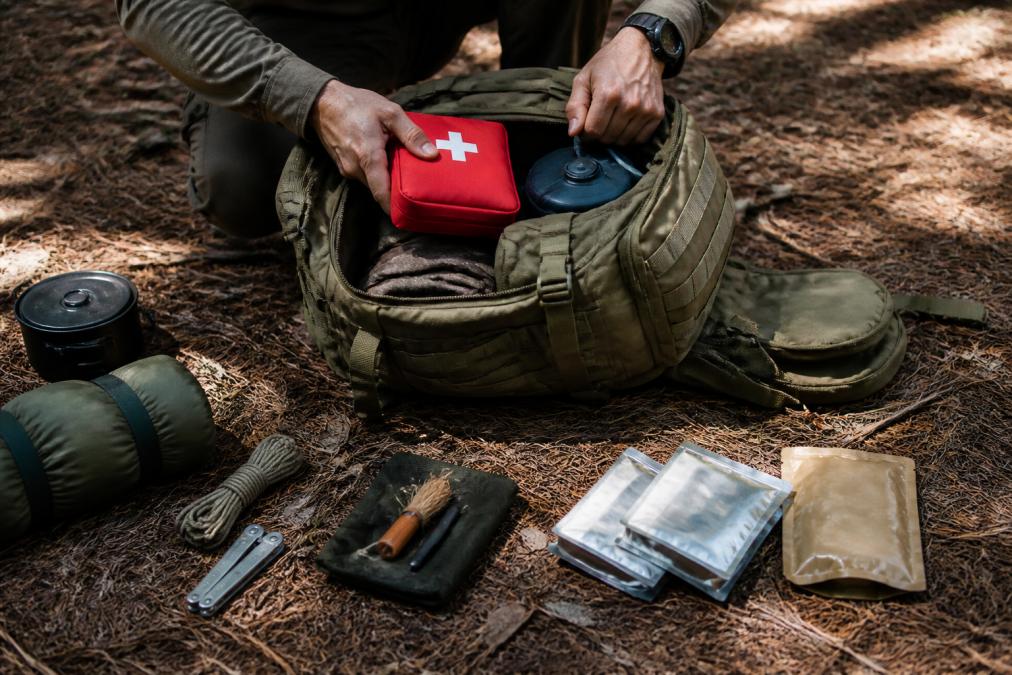
The FEMA emergency preparedness guidelines recommend a minimum 72-hour supply kit as the baseline for personal emergency preparedness.
Layering Your Load: What Goes Where
The load-bearing principle for a bug-out bag is weight-to-spine: heaviest items closest to your back and centered vertically. This keeps the pack’s center of gravity close to your body, reducing the lever arm that makes heavy packs feel unwieldy.
Recommended layering:
- Against the back panel: Hydration bladder, heaviest food items, shelter components
- Center of pack: Clothing layers, first aid kit, tools
- Top of main compartment: Items you’ll access first: rain gear, navigation, communication
- External MOLLE attachments: Items you need without opening the pack: gloves, small tools, quick-access pouches
- Hip belt pockets (if equipped): Snacks, compass, small flashlight
Keep your CCW compartment clear of secondary items. Its purpose is single-function access.
Hydration Bladder Compatibility and Placement
Most tactical backpacks in the 25-liter-and-above range include a dedicated hydration sleeve and a port for routing the drink tube. The sleeve should position the bladder against or near the back panel for weight distribution and to protect it from puncture by hard items in the main compartment. A 2-liter bladder is the standard for day use. For a 72-hour bug-out bag, a 3-liter bladder plus water purification capability is more practical.
TSA Compliance, Travel, and Field Maintenance Tips
Tactical backpacks and air travel create friction that most gear guides ignore. The tactical aesthetic triggers additional screening, and certain MOLLE-mounted accessories may require removal or checked-bag stowing. The TSA prohibited items list is the authoritative reference for what can and cannot travel in carry-on bags.
Practical steps for tactical travel:
- Remove all MOLLE attachments before reaching security.
- Stow waist belts and sternum straps inside the pack or secure them flat.
- Use a grey-man pack like the Vertx Gamut 2.0 or GORUCK GR1 for travel.
- Check CCW compartments are empty.
Field maintenance extends pack life significantly. Most Cordura and ballistic nylon packs can be hand-washed with mild soap and cold water. Avoid machine washing, which stresses stitching and zipper pulls. After wet-weather use, open all compartments and allow the pack to dry fully before storage to prevent mildew.
Zipper maintenance is the most overlooked field task. A light application of zipper lubricant every few months keeps YKK zippers operating smoothly and prevents corrosion that eventually causes failure. Inspect stitching at MOLLE attachment points periodically; these are the highest-stress areas on any loaded pack.
Never store a tactical backpack compressed or folded for extended periods. Sustained compression degrades foam padding in shoulder straps and back panels permanently, reducing both comfort and load-bearing performance.
| Maintenance Task | Frequency | Method |
|---|---|---|
| Full hand wash | Every 3-6 months or after heavy use | Mild soap, cold water, air dry |
| Zipper lubrication | Every 3 months | Purpose-made zipper lubricant |
| MOLLE stitching inspection | Monthly if heavily loaded | Visual check at attachment points |
| Back panel foam check | Every 6 months | Press test for compression loss |
| Hydration sleeve dry-out | After every use | Open, invert, air dry fully |
Frequently Asked Questions
What features should I look for in a high-quality tactical backpack?
Prioritize fabric denier (1000D Cordura or ballistic nylon holds up best), YKK zippers, and a MOLLE or PALS webbing system for modular attachment. A padded suspension system with a sternum strap and waist belt matters most for load carriage comfort. Also check for a dedicated hydration bladder sleeve, a padded laptop compartment, and water-resistant coatings. For CCW users, a quick-access concealed carry pocket with loop lining is a key addition.
Are tactical backpacks worth it for everyday carry?
Yes, for the right person. A well-built EDC tactical backpack offers compartmentalization that standard bags lack, dedicated laptop sleeves, quick-access pockets, and modular storage you can reconfigure with MOLLE attachments. If you carry a lot of gear daily, the organization alone justifies the cost. Casual users who carry a laptop and a few items may find a 20-25 liter pack sufficient without paying for full bug-out-bag features.
What is the difference between a tactical backpack and a hiking backpack?
Hiking backpacks prioritize weight savings, ventilated back panels, and hip-belt load transfer for long trail miles. Tactical backpacks trade some of that ventilation for modular MOLLE webbing, reinforced fabric like 1000D Cordura, CCW compartments, and more compartmentalization. Tactical packs also tend to have a lower profile and a more subdued aesthetic. For multi-day trail use, a hiking pack is often more comfortable; for preparedness and EDC, a tactical pack wins on organization and durability.
How do I choose the right capacity for a tactical backpack?
Match capacity to your use case. For EDC and commuting, 20-30 liters covers a laptop, daily essentials, and a day's worth of gear. A 30-40 liter pack suits overnight trips or a well-stocked bug-out bag. For 72-hour emergency preparedness or extended field use, 50+ liters gives you room for food, water, shelter, and clothing. Going too large for daily carry adds unnecessary weight and bulk, so size down when in doubt.
What materials are most durable for tactical gear?
1000D Cordura nylon is the field standard for heavy-duty tactical backpacks, offering strong abrasion resistance at a manageable weight. Ballistic nylon, used in some packs, is even more cut-resistant but heavier. Ripstop weaves add tear resistance without much weight penalty. For zippers, YKK is the benchmark, they hold up under repeated use and harsh conditions. Water-resistant coatings (DWR) help in light rain but are not a substitute for a rain cover on extended wet-weather missions.
The right tactical backpack is the difference between gear you trust completely and gear you’re quietly hoping holds up. Adventurers Pulse curates packs built to perform across mountain trails, forest campsites, and off-grid environments where failure isn’t an option. Browse our selection of field-tested tactical backpacks and find the setup that matches your mission. Shop Now.
This article was written using GrandRanker




0 Comments