
Table of Contents
- Ultralight Backpacking Gear List: The Big Four for 2026
- How to Reduce Pack Weight for Hiking: Proven Strategies
- Essential Survival Tools for Hikers: Safety Without the Weight
- Top Lightweight Backpacks for Long Distance Hiking
- Lightweight Clothing and Layering for Long Distance Hiking
- Budget-Friendly vs. Premium Lightweight Gear
- Eco-Friendly Gear Maintenance and Sustainability
- Conclusion
- Frequently Asked Questions
Last Updated: September 16, 2026
Ultralight Backpacking Gear List: The Big Four for 2026
The core of any lightweight gear for long distance hiking setup comes down to four items: pack, shelter, sleep system, and footwear. Get these right and everything else follows.
Pack: Hyperlite Mountain Gear Unbound 40
The Hyperlite Mountain Gear Unbound 40 is the benchmark for thru-hikers who prioritize weight-to-durability ratio. Its Dyneema Composite Fabrics resist weather and abrasion while keeping the pack around 2 pounds. The roll-top closure adjusts volume as your food supply shrinks. The main drawback: minimal padding means you need a dialed-in packing strategy to stay comfortable.
Shelter: Trekking-Pole Tents and Tarps
Shelter is where the biggest weight savings hide. A double-wall freestanding tent typically runs 3 to 5 pounds. A single-wall trekking-pole shelter in Dyneema or silnylon can drop to 1 to 2 pounds. The trade-off is condensation management and pitching skill: single-wall shelters require ventilation awareness and a taut pitch, or you wake up wet.
Sleep System: Quilt, Pad, and R-Value
Sleep systems have seen the biggest weight reductions in recent years. A trekking-pole-supported tent paired with a quilt and inflatable pad can weigh under 4 pounds total. A quilt saves weight by eliminating the hood and back insulation you compress anyway. Most quilt makers recommend a rating 10 degrees below your coldest expected temperature to account for draft and metabolism variation.
Footwear: Trail Runners vs. Boots
Trail running shoes have become the default for long-distance hiking on maintained trails. They’re lighter, drain faster, and reduce blister risk once your feet and ankles adapt. The trade-off is less ankle support and faster wear; expect 500 to 700 miles per pair. Boots still make sense for heavy loads, rough off-trail terrain, or hikers with ankle instability.
How to Reduce Pack Weight for Hiking: Proven Strategies
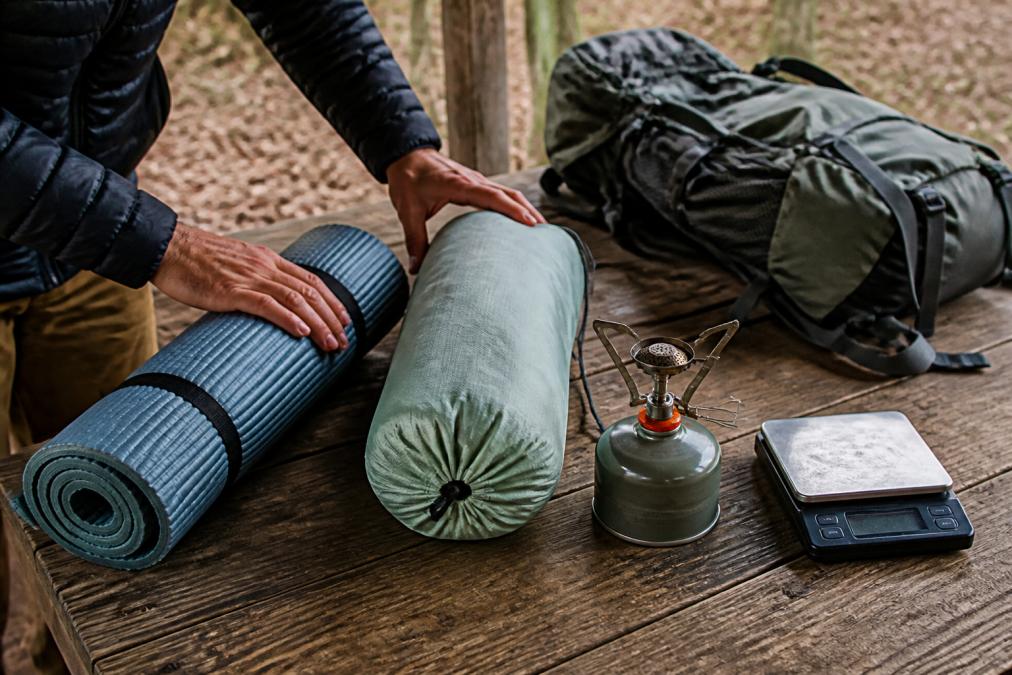
The fastest way to reduce pack weight for hiking is to weigh every single item and eliminate anything that isn’t used on most trips. Most hikers carry 3-5 pounds of “just in case” gear they never touch. Start with a kitchen scale and a spreadsheet.
Weigh Every Item and Cut the Big Three
Your Big Three (pack, shelter, sleep system) typically account for 60% of base weight. Cutting 2 pounds here beats shaving grams off your toothbrush. Replace heavy tent stakes with titanium versions. Swap a bulky sleeping bag for a quilt. Choose a frameless pack if your total load stays under 25 pounds.
Multi-Use Gear and Smart Packing
Multi-use gear is where experienced hikers win. A trekking pole becomes a tent support. A sit pad doubles as pack padding. Your cooking pot can be your bowl and mug. Pack heavy items close to your spine and centered between your shoulder blades for better weight distribution.
| Strategy | Weight Saved | Effort Level | Best For |
|---|---|---|---|
| Swap to quilt | 1-2 lbs | Medium | Three-season trips |
| Titanium stakes | 4-8 oz | Low | All trips |
| Frameless pack | 1-2 lbs | High | Sub-25 lb loads |
| Multi-use items | 8-16 oz | Low | All trips |
| Repackage toiletries | 3-6 oz | Low | All trips |
Repackage everything. Sunscreen, toothpaste, and bug spray all come in heavy containers. Squeeze them into smaller dropper bottles. This alone can save half a pound and takes 20 minutes.
Essential Survival Tools for Hikers: Safety Without the Weight
Essential survival tools for hikers should cover navigation, communication, first aid, and emergency shelter without adding unnecessary ounces. The goal isn’t to carry a full survival kit. It’s to carry the right tools that address the most likely emergencies on a long-distance trail. Most practitioners find the real risk isn’t a dramatic injury; it’s getting lost, running out of water, or a minor issue that compounds when you’re tired and far from a trailhead.
Navigation and Communication
A GPS device or smartphone app with offline maps handles navigation. Download maps before you leave; cell service disappears fast in canyons and mountains. Carry a portable power bank to keep devices charged over multi-day stretches, and keep the phone in airplane mode to stretch battery life.
First Aid and Emergency Kit
Your emergency kit should fit in a quart-sized bag. Include blister treatment, pain relievers, antihistamines, a small roll of medical tape, and a multi-tool. Add a headlamp with spare batteries, a fire starter, and an emergency bivy. A water filtration system is non-negotiable. Squeeze filters and purification tablets weigh almost nothing and prevent the most common backcountry illness.
Digital Detox and Safety Protocols
Here’s an angle most gear guides skip: the psychological side of long-distance hiking is part of your safety system. Constant phone use drains batteries you need for navigation and emergencies, and it pulls attention away from terrain and weather cues. A common pattern is to designate set check-in windows, such as once each evening, and keep the phone off otherwise.
Skipping a water filtration system to save 3 ounces is the mistake that ends trips. Giardia and other waterborne pathogens will sideline you for days. Always carry a filter or purification method.
Test your satellite messenger and download offline maps at home before your trip. A device you haven’t practiced with is not a safety tool.
Top Lightweight Backpacks for Long Distance Hiking
The best lightweight backpack for long distance hiking balances weight, durability, and load comfort. No single pack wins for everyone. Your choice depends on base weight, torso length, and whether you prioritize ventilation or minimum ounces.
Gossamer Gear Gorilla 50
The Gorilla 50 is the pack we recommend most often to hikers transitioning from traditional gear to ultralight setups. The removable internal frame stay lets you strip it down further as your kit gets lighter. Large mesh outer pockets handle wet gear, and integrated hip belt pockets keep snacks accessible.
Osprey Atmos AG 65
The Atmos AG 65 is for hikers who prioritize comfort and ventilation over absolute minimum weight. The Anti-Gravity suspension system distributes weight across your hips and back in a way that frameless packs simply can’t match. The fit-on-the-fly hip belt adjusts on the trail, and an integrated raincover is included.
Zpacks Arc Haul Ultra 50L
Zpacks built the Arc Haul Ultra 50L with Ultra 100/200 fabric for increased abrasion resistance. The adjustable torso length and arc tension system let you fine-tune fit, and modular attachment points accommodate accessories. The strength-to-weight ratio is exceptional. The catch: the complex adjustment system frustrates beginners. Plan to spend an hour dialing it in before your first trip.
Gossamer Gear Mariposa 60
The Mariposa 60 solves a specific problem: long food carries. Seven external pockets keep everything organized, and the removable sit pad back panel doubles as camp furniture. Load lifter straps manage weight effectively for multi-day hauls. It’s bulky in tight spaces, but if you’re doing 7-day stretches between resupply, the capacity justifies the footprint.
Lightweight Clothing and Layering for Long Distance Hiking
A three-layer clothing system handles almost every condition on a long-distance trail. Your base layer manages moisture, your mid-layer provides insulation, and your shell blocks wind and rain. Get these three right and you can leave the extra jackets at home.
Budget-Friendly vs. Premium Lightweight Gear
You don’t need to spend $2,000 to go ultralight. Budget-friendly and premium lightweight gear often share the same design philosophy; the difference is materials and lifespan. An Osprey Hikelite 26 handles day hikes and minimalist summit pushes with an AirSpeed trampoline suspension and integrated raincover. A Hyperlite Unbound 40 handles thru-hikes. Both are lightweight.
Buy your pack last. Once you know the weight and volume of your gear, you can choose a pack that fits your actual kit instead of guessing.
Eco-Friendly Gear Maintenance and Sustainability
Eco-friendly gear maintenance extends the life of your equipment and keeps it out of landfills. The most sustainable piece of gear is the one you already own. Clean your gear after every trip, repair small tears before they spread, and store insulation loosely rather than compressed.
Conclusion
Building a lightweight gear for long distance hiking setup takes experimentation, and the first version won’t be perfect. The challenge is knowing which items to invest in and which to upgrade later.
Frequently Asked Questions
What is the ‘Big Four’ in lightweight backpacking?
The Big Four are your backpack, shelter, sleeping bag, and sleeping pad. These items typically make up 60-70% of your base weight, so upgrading them to lightweight versions gives the biggest weight savings. For example, a Dyneema Composite Fabrics pack like the Hyperlite Mountain Gear Unbound 40 weighs under 2 pounds, while a traditional pack can exceed 4 pounds. Focus on these four first when reducing pack weight.
How do you pack lightweight gear for a multi-day hike?
Start with a gear list and weigh every item. Place heavy items like food and water close to your spine and centered between your shoulder blades. Use compression sacks for bulky items like sleeping bags. Keep frequently used items in external pockets. Aim for a base weight under 20 pounds for multi-day trips. For a 3-day hike, you might carry 1.5 to 2 pounds of food per day. Test your pack on shorter trips before a long-distance hike.
What are the 10 essential items for long-distance hiking?
The classic 10 essentials include navigation (map, compass, GPS), sun protection, insulation, illumination, first-aid supplies, fire, repair tools, nutrition, hydration, and emergency shelter. For long-distance hiking, add a portable power bank and water filtration. Lightweight options like the Nocs Provisions Zero Tube monocular for navigation and a compact water filter help keep your pack light. Always tailor the list to your specific trail and conditions.
How much should a lightweight hiking pack weigh?
A lightweight backpack for long-distance hiking typically weighs between 2 and 3 pounds. Ultralight packs can be under 2 pounds, while traditional packs often exceed 4 pounds. Your total pack weight (base weight plus consumables) should ideally be under 20 pounds for comfortable long-distance hiking. The Gossamer Gear Gorilla 50 weighs around 2 pounds, making it a solid choice for reducing pack weight without sacrificing comfort.
What is the most forgotten item when preparing for a long hike?
Many hikers forget a repair kit for their gear. A small roll of duct tape, spare buckles, and a multi-tool can save a trip when a strap breaks or a tent pole splinters. Also commonly forgotten: a headlamp with extra batteries, sunscreen stick, and a backup water treatment method. Create a checklist and double-check it before you leave. A lightweight repair kit weighs only a few ounces but prevents major problems.




0 Comments